
Oklahoma Bar Journal
Tax Stamp as Drug Law in Action
By Kat Albrecht, Corey Boyd, Samuel Galoob and Stephen Galoob
Prosecutorial charging “is where American criminal law becomes operative.”[1] This article examines prosecutorial charging by focusing on a specific offense in Oklahoma – Possession of a Controlled Substance Without a Tax Stamp (colloquially called Tax Stamp and codified 68 Okla. Stat. §450.8).
TAX STAMP
In November 2016, Oklahoma voters approved State Question 780, which made the offense of “Possession of Controlled Dangerous Substance” (simple possession) a misdemeanor but did not change any other drug laws or penalties. Oklahoma prosecutors vigorously opposed SQ 780 in the runup to the 2016 election, arguing that it would deprive them of crucial tools that they needed to promote public safety.[2] Some prosecutors also seemed to resist SQ 780 after it went into effect. One study found that the number of “Possession of a Controlled Substance With Intent to Distribute” (PWID) charges across Oklahoma rose almost 15% in the year after SQ 780 went into effect.[3] That study found evidence consistent with the hypothesis that Oklahoma prosecutors substituted felonies such as PWID for conduct that, prior to the enactment of SQ 780, would have previously been charged as simple possession.[4]
Tax stamp is another drug offense that could be substituted for the charge of simple possession. Adopted in 1990, §450.8 forbids any “dealer” from manufacturing, distributing, producing, shipping, transporting, importing, or possessing a controlled dangerous substance without affixing the appropriate tax stamp. The term “dealer” is defined as “a person who in violation of the Uniform Controlled Dangerous Substance Act… in any manner possesses more than 42 ½ grams of marihuana, or seven or more grams of any controlled dangerous substance other than marihuana, or ten or more dosage units of any controlled dangerous substance other than marihuana which is not sold by weight.”[5] Tax stamp charges can be brought alongside other drug crimes without violating 21 Okla. Stat. §11, the statutory prohibition on multiple punishment.[6] Prior to 2026, tax stamp was punishable by up to five years’ imprisonment on a first offense.[7]
PATTERNS OF CHANGE IN TAX STAMP PROSECUTIONS
There has been a significant increase in tax stamp prosecutions since the passage of SQ 780. The following table summarizes the total number of tax stamp cases filed annually between 2015-2025.
TABLE 1: TOTAL NUMBER OF TAX STAMP CASES IN OKLAHOMA, 2015-2025
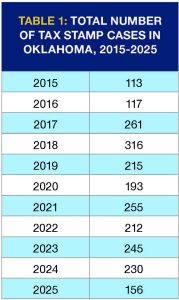
In the six years after the effective date of SQ 780, the average number of tax stamp charges filed annually was 239.5 statewide – a 208% annual increase compared to the two-year period immediately prior.
Unlike the increase in PWID charges (which was realized in a majority of Oklahoma’s counties), the proliferation of tax stamp charges was concentrated in a few high-filing counties. During the 2015-2026 period, only 54 Oklahoma counties had even a single tax stamp charge filed, and 14 of these counties had only one or two tax stamp charges filed. However, during this period approximately 75% of all tax stamp charges were concentrated in seven high-filing counties: Cleveland, Craig, Garvin, Mayes, Rogers, Texas, and Tulsa. Here is a breakdown of the total number of tax stamp charges filed in these seven counties during the 2015-2025 period.
TABLE 2: TOTAL TAX STAMP CASES BY COUNTY, 2015-2025
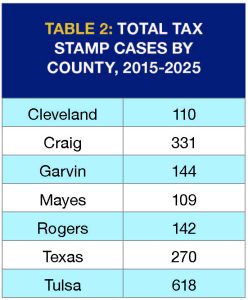
These high-filing counties are not uniform in their population or any other significant characteristics. Tulsa County (698,782 estimated population in 2025) and Cleveland County (303,973) have the second- and third-largest populations of any Oklahoma counties, and Rogers County has the sixth-highest estimated population at 102,197.[8] However, the remainder of these high-filing counties have estimated populations between 14,000 and 39,500, ranking between 27th and 48th among the 77 Oklahoma counties.[9] By contrast, the largest county in the state, Oklahoma County, had only one tax stamp charge during the period between 2015-2025. For each of these seven high-filing counties, the rate of tax stamp charges filed dramatically increased after the passage of SQ 780 in November 2016 and the effective date of the law in June 2017.
THE TAX STAMP EXPLOSION: TWO HYPOTHESES
What explains this proliferation of tax stamp charges? One possible hypothesis is that the increase in tax stamp charges was a response to an increased number of tax stamp offenses. However, this public safety hypothesis is not credible. First, any case that could be charged as the felony of tax stamp could instead be charged as simple possession (a misdemeanor), and most such cases could also be charged as PWID (a felony). Second, if filing tax stamp charges were a good way to protect public safety, then we would expect that law enforcement officials would have filed such charges prior to the passage of State Question 780. Moreover, as noted below, an audit study of tax stamp charges in one high-filing county indicates that few people convicted of a tax stamp charge serve any period of incarceration on that charge.
Another possible explanation is the substitution hypothesis: perhaps prosecutors filed felony tax stamp charges in cases where they might have filed charges for the felony of simple possession prior to 2017, but were precluded from doing so by SQ 780. On this substitution hypothesis, filing tax stamp charges would provide a backdoor way of felonizing simple possession, one that allows prosecutors to exercise “compassionate leverage”[10] by charging low-level drug offenders with felonies. If the substitution hypothesis is correct, then one would expect to see many cases in which the tax stamp charge was the most serious charge filed.
The revenue generation hypothesis provides another possible explanation for the pattern of tax stamp charges. On this hypothesis, tax stamp charges are primarily mechanisms for generating revenue from legal-financial obligations associated with filing and conviction. If this hypothesis were true, then we would expect tax stamp charges to be filed in cases where more serious drug charges were filed – for example, PWID, trafficking in drugs, or manufacturing, each of which carries a higher penalty on a first offense than does tax stamp. Defendants charged with tax stamp violations would routinely be convicted of these charges in plea deals but rarely serve any distinctive sentence for the tax stamp charge. Rather, any sentence for tax stamp offense would be served concurrently to the more-serious drug charge and expire before the culmination of the sentence for that more-serious charge. Moreover, if the goal of filing tax stamp charges is to generate revenue, then we would expect that the legal-financial obligations associated with tax stamp charges would rarely be waived or reduced.
AN AUDIT STUDY OF CRAIG COUNTY
To test these hypotheses about why Oklahoma prosecutors file tax stamp charges, we focused our attention on Craig County. Craig County has an estimated population of 14,115 people in 2020, which makes it the 48th largest county in Oklahoma.[11] Interstate 44 runs through the southern part of the county. Yet Craig County saw 328 tax stamp filings during the period between 2015-2025, the second-highest number of such filings of any county. Moreover, of the 159 total drug felony cases in 2021, 55 (or more than one-third) involved a charge of tax stamp.
For each Craig County case involving a tax stamp charge between 2017 and 2021,[12] we utilized data from the Oklahoma Supreme Court Network to identify whether there were other drug charges and, if so, which ones, and whether the defendant served time on the tax stamp charge(s). We also noted whether any sentence served on tax stamp charges was distinctive or whether it was duplicative (for example, a sentence served concurrently to another/longer drug sentence, a deferred sentence, or a suspended sentence). This information would help assess whether tax stamp charging patterns are consistent with the substitution hypothesis or the revenue generation hypothesis.
Based on our analysis, the patterns of charging and conviction in Craig County are more consistent with the revenue generation hypothesis than the substitution hypothesis. Of the 139 Craig County cases between 2017 and 2021 for which we obtained court records, 136 of them involved a more serious drug charge such as PWID or trafficking. These results suggest that tax stamp charges were a tag-along to more serious felony drug charges, rather than a substitution for misdemeanor charges of simple possession.
Our study also provided data about the resolution of tax stamp cases in Craig County. Of the 138 Craig County cases between 2017-2021 that involve a tax stamp charge, 27 have been dismissed, 17 involve a sentence or term that is consecutive to another sentence, and 84 involved a sentence to be served concurrently to the sentence for a more-serious drug charge. For this latter category of cases, the defendant convicted of the tax stamp offense will not serve any distinctive time for that offense. In only 14 cases was a defendant convicted of tax stamp charges and sentenced to any distinctive time for that charge. Eleven of these 14 cases involved a sentence that was either deferred (under which a defendant is released from custody and given the chance to complete probation before a certain date) or suspended (which the defendant is allowed to serve outside of the prison system). In other words, of the 138 tax stamp charges, only three resulted in the defendant serving a specific sentence of incarceration for the charge.[13]
These results are more consistent with the revenue generation hypothesis than the substitution hypothesis. In Craig County, tax stamp convictions rarely result in any distinctive incarceration. However, each of these convictions resulted in approximately $400 in court costs, and the most common fine associated with tax stamp convictions was $500. In addition, those convicted of tax stamp charges are required to pay a supervision fee to the district attorney if they are released on probation. Based on these figures, we estimate that tax stamp charges in Craig County resulted in well over $2 million in assessments of legal-financial obligations to defendants since 2017. Moreover, while more-serious drug charges were routinely reduced through the plea-bargaining process (for example, from aggravated trafficking to trafficking, or from trafficking to PWID), we found only seven cases from Craig County during the relevant period in which the tax stamp charges was specifically resolved through plea bargaining.
By way of comparison, consider the tax stamp filings in Cimarron County and Beaver County. Cimarron County, in far western Oklahoma, is the smallest county in Oklahoma, with an estimated population of 2,059 in 2025. Nearby Beaver County had an estimated population of 4,882 in 2025.[14]
In Cimarron and Beaver Counties, tax stamp charges are filed much less frequently than in Craig County: 49 in Cimarron between 2015-2025 (43 of which were charged after the passage of SQ 780 in 2016) and 23 in Beaver. Moreover, there’s a different pattern to resolving tax stamp cases in these counties than in Craig County. In both Beaver County and Cimarron County, tax stamp charges were much more likely to be dismissed through plea bargaining and also more likely to result in distinctive sentences of incarceration.[15] These results suggest that courts in Beaver County and Cimarron County were much more likely to both dismiss tax stamp charges and to sentence defendants convicted of tax stamp charges than courts in Craig County.
In sum, the results from Craig County are consistent with the revenue generation hypothesis. Craig County prosecutors filed tax stamp charges often, especially in light of the low population levels and low number of felony charges in the county. Tax stamp charges rarely resulted in distinctive sentences of incarceration for defendants. Yet Craig County courts also dismissed tax stamp charges far less frequently than courts in comparable jurisdictions. These results suggest that the point of filing and convicting on tax stamp charges was to generate revenue, rather than to promote public safety.
CONCLUSION
Although tax stamp charges have significantly increased, the offense is not one of the most frequently charged offenses in Oklahoma’s criminal system. That said, the pattern of tax stamp prosecutions illustrates at least two broader critiques of Oklahoma criminal law in action.
First, the proliferation of tax stamp prosecutions since 2017 is an example of prosecutorial discretion. The lack of incarceration associated with tax stamp prosecutions indicates that the rationale for these charges is likely not public safety. Rather, the proliferation in tax stamp charges since 2017 is more plausibly a feature of the broader financial incentives of district attorneys to generate revenue from charging offenses. This incentive is specifically enabled for the charge of tax stamp, to which the Court of Criminal Appeals has been unwilling to apply Oklahoma’s statutory prohibition on charge stacking.[16] Tax stamp cases therefore illustrate the pattern of “profit-driven prosecution”[17] that is often critiqued but difficult to identify or dislodge.
Second, the geographic concentration of tax stamp cases raises broader questions about prosecutorial accountability for charging decisions. Prosecutors are “the most powerful actors in the criminal justice system,”[18] and prosecutorial charging decisions reflect the apotheosis of that power. Yet there are no uniform standards for how cases should be charged across (and often within) jurisdictions. It is difficult to imagine that county-level disparities like those evinced in tax stamp prosecutions would be tolerated for other kinds of discretionary decisions by public officials.
Authors Note: The authors are grateful to Ryan Gentzler and the team at Open Justice Oklahoma for conducting the initial research on tax stamp charges in 2022. This research is an outgrowth of Samuel Galoob’s mid-year project at Booker T. Washington High School.
ABOUT THE AUTHORS
 Kat Albrecht is assistant professor of law at the TU College of Law, where she teaches and researches data law and technology, criminal law, and evidence. She is a graduate of the University of Minnesota, Northwestern University (where she received her J.D. and Ph.D.), and the University of Georgia (where she received an M.F.A. in screenwriting).
 Corey Boyd is a student at the TU College of Law, where he serves as a 10th Circuit Year-in-Review fellow. He is a graduate of Southwestern Oklahoma State University, where he earned a bachelor’s degree in finance. Prior to attending law school, Mr. Boyd served 11 years as a law enforcement officer, finishing his career at the rank of detective. He is interested in criminal law and civil rights litigation.
Sam Galoob is an undergraduate student at TU. The research in this article is an outgrowth of his midyear project at Booker T. Washington High School, where he received the IB diploma.
 Stephen Galoob is professor of law at the TU College of Law, where he teaches criminal law and related topics. He is a graduate of OU, the University of Virginia School of Law, and the University of California-Berkeley (where he received his Ph.D. in jurisprudence and social policy).
ENDNOTES
[1] Shima Baradaran Baughman, Alan Cicotte, and Kristina Bishop, “The Police-Prosecutor Charging Decision,” Iowa Law Review (forthcoming 2026).
[2] Stephen R. Galoob, Colleen McCarty & Ryan Gentzler, “Oklahoma’s State Question 780: Criminal Justice Reform and Resistance,” 31 Fed. Sent. Rptr. 182 (2019).
[3] Id. at 183-4.
[4] Id. at 184-5.
[5] 68 Okla. Stat. §450.1(2). These minimum quantities are significantly lower than the quantities specified in Oklahoma’s Trafficking statute, 63 Okla. Stat. §2-415.
[6]See, e.g., Brian Boeheim, David Dossman, and Stephen Galoob, Oklahoma Criminal Law and Procedure With Forms (2025 ed.), at §5.03 (citing White v. State, 1995 OK CR 15, 900 P.2d 982 (Okla. Crim. App. 1995)). The sole exception is that tax stamp charges cannot be charged alongside simple possession, since simple possession charges do not contain any elements that are not also elements of tax stamp charges. Id.
[7] Under the Sentencing Modernization Act effective Jan. 1, 2026, tax stamp is a D1 felony punishable by up to five years imprisonment on a first offense with a requirement to serve at least 20% of a sentence before release from custody. 21 O.S. §20N (2026)
[8] United States Census Bureau, “County Population Totals and Components of Change: 2020 2025,” https://bit.ly/4fgBB4K.
[9] Id.
[10] Galoob, Gentzler, and McCarty, supra n. 2, at 182.
[11] United States Census Bureau, “County Population Totals and Components of Change: 2020 2025,” supra n. 8.
[12] We cut off our study at this date to minimize the number of active cases under analysis.
[13] Two of these three cases involved a jury trial. Under Oklahoma law, juries decide not only whether a defendant is guilty but also what the sentence for any offense is.
[14] United States Census Bureau, County Population Totals and Components of Change: 2020 2025, supra n. 8.
[15] For example, of 19 cases in Beaver County between 2017-2021 involving a tax stamp charge, the tax stamp charge was dismissed through plea bargaining in nine cases and the defendant was sentenced to distinctive incarceration for the tax stamp charge in four cases. Likewise, of the 26 cases in Cimarron County between 2017-2021 involving a tax stamp charge, the tax stamp charge was dismissed through plea bargaining in 17 cases and the defendant was sentenced to distinctive incarceration for the tax stamp charge in two cases.
[16] See Boeheim, Dossman, and Galoob, supra n. 6, at §5.03 (summarizing cases).
[17] Maybell Romero, “Profit-Driven Prosecution and the Competitive Bidding Process,” 107 J. Crim. L. & Criminology 161, 168 (2017) (identifying structural drivers that impose “greater pressure and incentives for prosecutors not only to save costs but also to generate revenue.”)
[18] John Pfaff, Locked In: The True Causes of Mass Incarceration – and How to Achieve Real Reform, 133 (2017)
Originally published in the Oklahoma Bar Journal – OBJ 97 No. 6 (August 2026)
Statements or opinions expressed in the Oklahoma Bar Journal are those of the authors and do not necessarily reflect those of the Oklahoma Bar Association, its officers, Board of Governors, Board of Editors or staff.