
Oklahoma Bar Journal
Bar Foundation News | Expanding Access to Justice Through OBF’s Court Interpreter Support
By Renee DeMoss
In the legal system, language accuracy is a matter of justice. For individuals who are considered limited English proficiency (LEP), access to justice depends on their ability to understand a language through a qualified interpreter:
“Many persons who come before the court are partially or completely excluded from full participation in the proceedings due to limited English proficiency … it is essential that the resulting communication barrier be removed as far as possible, so that these persons are placed in the same position as similarly situated persons for whom there is no such barrier.”[i]
 The purpose of a courtroom interpreter is to help LEP individuals communicate and understand the proceedings in a judicial environment. This role involves more than just translating court proceedings word for word. It also includes depicting the meaning, tone, and style of the speaker while remaining impartial. Qualified interpreters play a pivotal role in ensuring access to justice and helping court proceedings function efficiently and effectively.
In Oklahoma, two levels of courtroom interpreter credentials are recognized. “Certified courtroom interpreters” hold the highest level of credential, and “registered courtroom interpreters” hold the second highest level of credential. An interpreter candidate must first pass the test to become registered, and then he or she may take the exam to become fully certified.
Certified courtroom interpreters have established the interpreter’s competence as a language professional, evidencing the ability to interpret complex legal proceedings with precision and neutrality, even in high pressure situations. A registered interpreter knows both languages fluently, but a certified interpreter has been specifically tested in live interpreting. Oklahoma statutes require a district court to first determine that a certified interpreter is not available before using a registered interpreter.[ii]
The interpreter exams are both challenging, but the certified exam is particularly so, even for individuals who are extremely proficient in both languages. An interpreter is required to listen, comprehend, translate, and produce the interpretation with speed and accuracy, including legal terms, common slang terms, and others. Poor or inaccurate interpretation can have devastating consequences, as in a New Mexico case where the defendant was convicted of rape and murder largely due to a denial that was misinterpreted as a confession.[iii]
Access to qualified court interpreters, particularly in rural Oklahoma, is a persistent challenge. As of May 1, there are only 30 certified interpreters on the Oklahoma registry of interpreters maintained by the Board of Examiners of Certified Court Interpreters, and only nine of those 30 individuals who are certified actually reside in Oklahoma.
Financial barriers are another part of the problem. Costs for registered interpreters to take the certification exam preclude many who seek to serve and advance in their careers by becoming certified interpreters. Similarly, many individuals lack the financial resources to train for the exams. Potential interpreters lack the opportunity to successfully take the registered exam.
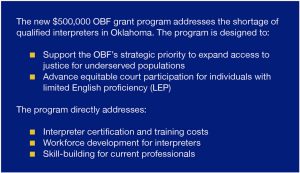
Therefore, the OBF has created a new $500,000 grant program to address the shortage of qualified interpreters in Oklahoma and to support the professional development of court interpreters across the state. The program is intended to 1) improve access to justice for LEP individuals, 2) reduce financial barriers for registered interpreters taking the exam to become certified interpreters, 3) provide a way for eligible certified interpreters to sharpen the skills necessary to successfully pass the exam, and 4) reduce financial barriers for individuals who desire to take the exam to become registered interpreters.
LEP individuals must have meaningful access to the courts. This requires highly trained certified courtroom interpreters who have proven abilities. Competent legal interpretation is a fundamental safeguard of justice, due process, and fairness in the courtroom, and the OBF program will promote these goals through its new grant program.
Ms. DeMoss is the executive director of the Oklahoma Bar Foundation.
ENDNOTES
[i] Preamble to the Code of Professional Responsibility for Interpreters, Rule 1, Title 20, Chap. 23, App. 1.
[ii] 20 Okla. Stat. 1710 (2025)
[iii] Mendez v. State of Arkansas, CR10-1241,2011 WL 6275689 (Ark., Dec. 15, 2011)
Originally published in the Oklahoma Bar Journal – OBJ 97 No. 6 (August 2026)
Statements or opinions expressed in the Oklahoma Bar Journal are those of the authors and do not necessarily reflect those of the Oklahoma Bar Association, its officers, Board of Governors, Board of Editors or staff.